Cast iron
The original nonstick was never a coating
One kind is applied on top of the metal and can only wear away. The other grows into it. Most cast iron still gets that wrong.
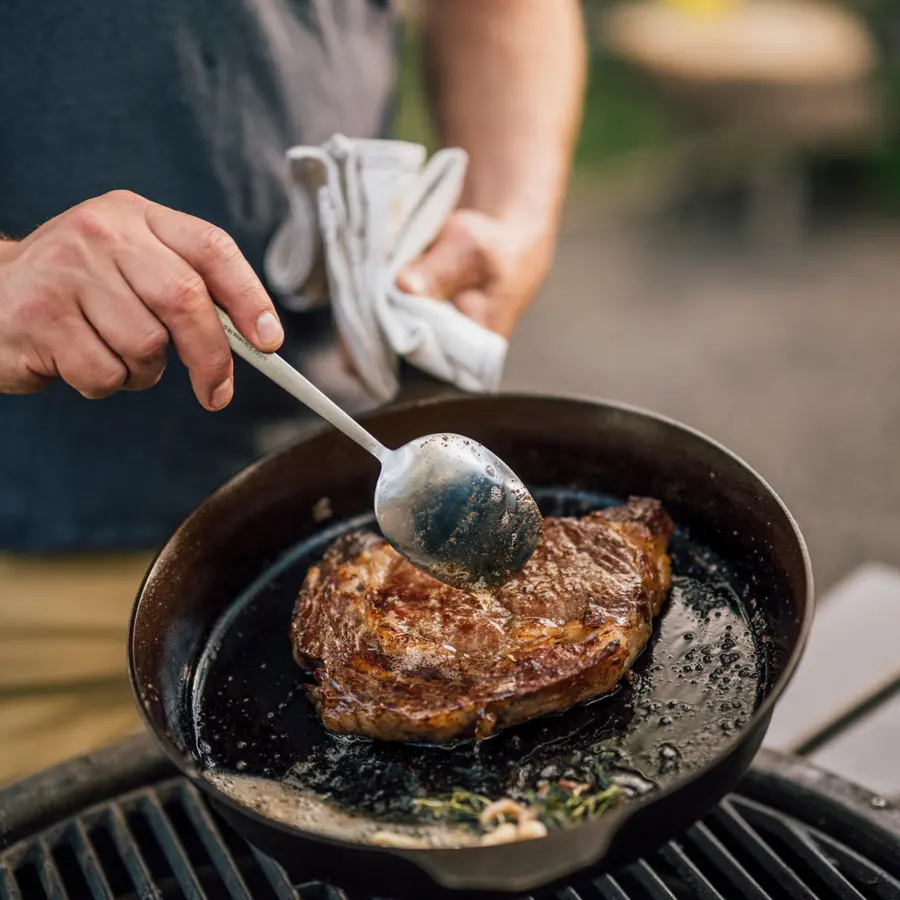
There is a pan in your kitchen that used to be nonstick. You remember the month eggs slid. You do not remember the month they stopped, because nothing announced it. At some point the pan quietly changed jobs, from the one you reach for to the one you scrub.
A Field Company customer named Geoffrey A. described that whole arc in four sentences. Field liked them enough to stop writing its own ad copy and run his, word for word, on Facebook:
Running now in Field Company's ads
“We were tired of replacing ‘non-stick’ pans when the coating started flaking off. I never had cast iron before, but read that it was ‘the original non-stick cookware.’ Decided to try Field's because they are polished very smooth and lighter than most; the cast iron I saw in stores was too bumpy. We followed the breaking-in advice and couldn't be happier with our cast iron. Fried eggs really do slide around!”
Geoffrey A., quoted in a Field Company advertisement active in the Meta Ad Library.
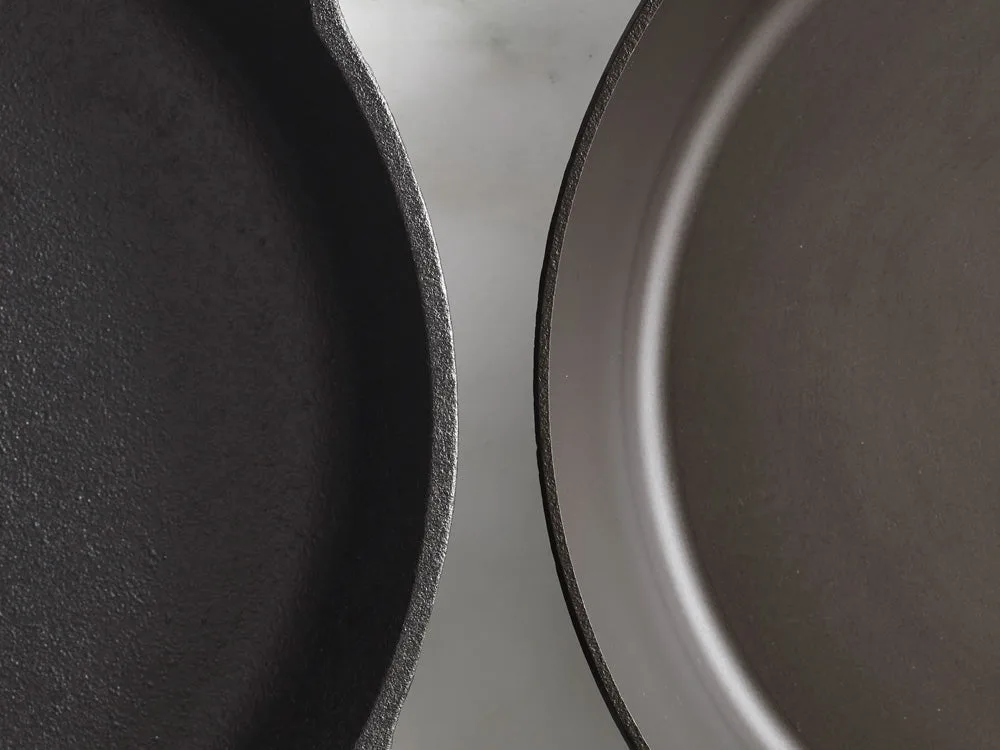
Read it again and you will notice he does two things almost nobody does. He explains why his old pans failed, and he explains why the obvious replacement, the cheap cast iron on the shelf at the store, looked wrong to him too.
Both of those things have a physical explanation. Neither is a matter of taste. And once you have them, the cookware aisle rearranges itself in front of you.
Part 01
A coating sits on the metal. Seasoning grows into it.
Start with the pan that failed. A conventional nonstick pan is a piece of metal with a slick layer applied to its surface. That layer is the product. It arrives at its best, and every heat cycle, every metal spatula, every scrub after a bad night is a small withdrawal from a balance that was never going to be topped up. The day it stops releasing an egg is not the day it broke. It is the day the withdrawals added up.
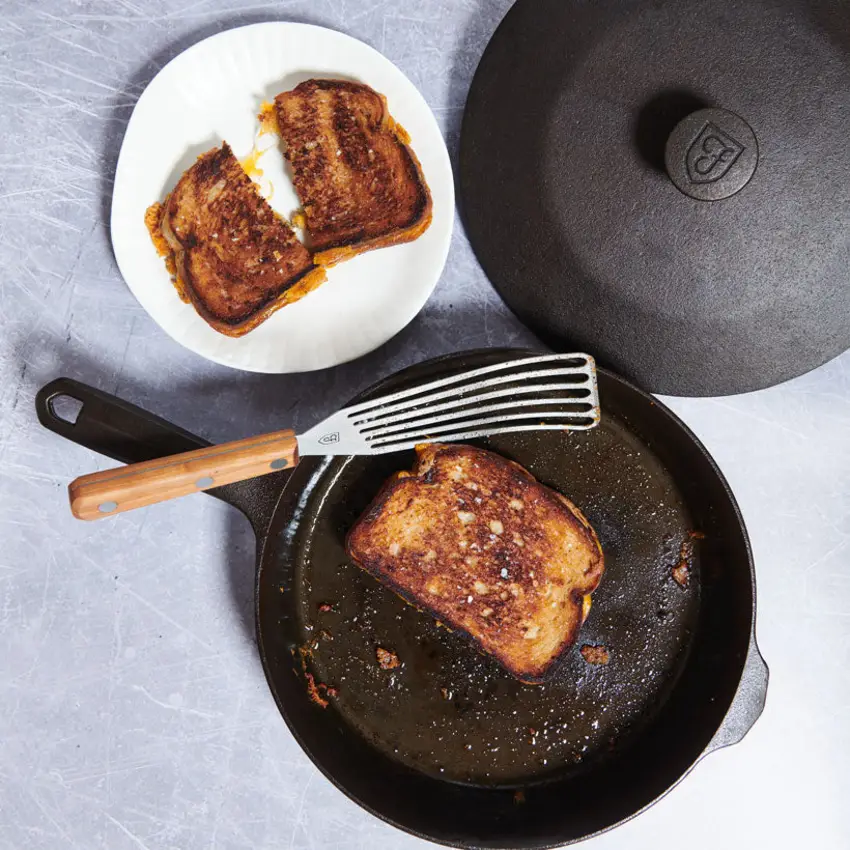
Now the other kind. Cast iron does not arrive slick and it is not supposed to. What makes cast iron release food is a substance called seasoning, and Field, which sells the pans and also publishes the most detailed seasoning guide of any manufacturer we could find, defines it in one line:
The chemistry, in their words: “When subjected to high heat, long chains of fat molecules break down into short-chain polymers that bond with naturally produced carbon and bare iron, forming a kind of glaze.” They then say the quiet part out loud, which most cast iron brands avoid because it names the competition: the result “has smooth, non-stick properties similar to Teflon.”
So both surfaces are polymers. The difference is not what they are. The difference is where they live.
The whole argument, in cross section
Two nonstick surfaces on the same scale. What separates them is not slipperiness, it is whether the metal underneath is a partner or a substrate.
A. Applied coating
The layer is a separate material laid over the metal. Nothing anchors it except adhesion. Wear runs one way: away.
B. Grown seasoning
The iron surface is porous. Oil polymerizes into the pores first, then builds level with the peaks. Every meal adds a layer. Wear runs the other way: toward.
Schematic. Field's published description of seasoning is that it “bakes right into the iron, filling in those pores and smoothing everything out into an even surface.”
Field publishes its own version of that cross section, and it is worth looking at because of the fourth panel, which most brands would have cropped out.

That fourth panel is the one that matters later in this article, so hold onto it: seasoning fails by being too thick, not by being too thin. Field is blunt about why. “Thick layers of seasoning will scrape off with normal use. Only the thin layers, molecularly bonded to the pan and each other, will stand the test of time.” They compare it to paint on a windowsill: once moisture gets under a heavy coat, it lifts off in sheets.
Thin layers
Bond, and keep bonding
Each cooking session adds a film thin enough to fuse with the layer below. Field's phrase is molecularly bonded to the pan and to each other.
Thick layers
Sit, then lift
Piled on faster than they can bond. Field compares it to heavy paint on a windowsill: once moisture gets under, it comes off in sheets.
Part 02
One surface peaks on day one. The other never peaks.
This is the part that flips the buying decision, and it is uncomfortable in the way that true things about maintenance usually are.
A coated pan is at its best in the shop. A cast iron pan is at its worst in the shop. Field says so on its own product page instead of pretending otherwise: pre-seasoned pans are ready to use “but not fully nonstick yet,” and some sticking early on is normal. Their skillets ship with three baked coats of organic grapeseed oil, which they describe as deliberately less pre-seasoning than other producers apply, because their goal is to bake seasoning “into the pan, not on top of it.”
Read that against the competitor they are describing, again in their words: “other pans that try and speed up the process by covering up the iron with a more cosmetic top coat.” A heavy factory coat photographs beautifully and behaves exactly like the fourth panel above.
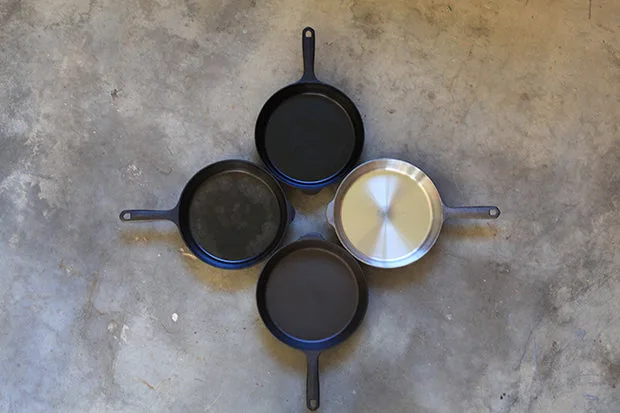
One of the link titles Field is running in its current ads is simply “Better With Every Cook.” On most brands that is a slogan. Here it is a description of the mechanism, and it is falsifiable: if the pan is not better in six months, the seasoning did not build.
Part 03
Then why did the cheap cast iron let you down?
Because Geoffrey A. was right about the pans in the store, and Field's own FAQ says so more directly than a competitor ever would. “Most modern cast iron is heavy and rough,” they write, sold in the state the industry calls as cast, straight out of the sand mold, to save on cost.
Sand casting leaves a coarse, pitted surface. It is not a defect, it is simply the raw output of the process, and finishing it costs money and time. A century ago the finishing was done by hand. Then most of the industry stopped doing it, and an entire generation grew up believing cast iron is a heavy thing that food sticks to.
Sold as cast
Rough from the mold
The sand cast texture is left in place. Deep pits hold thick, uneven deposits. Heavier walls, because thick is cheaper and safer to pour.
Machined after casting
Finished cooking surface
The surface is cut back to a controlled texture. Seasoning fills it thinly and evenly. Field describes its process as modelled on the best vintage cookware.
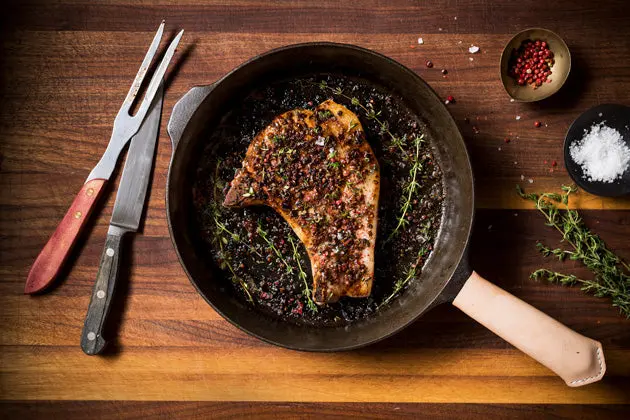
So the obvious conclusion is that you want the smoothest cast iron you can find. That conclusion is wrong, and the reason it is wrong is the most interesting thing Field has published.
Part 04
Smooth is not the goal. Smooth enough is.
Here is the sentence, from Field's design notes, that reorganizes the whole category:
Their explanation continues: “If the cooking surface is too smooth, that fresh layer of seasoning won't adhere,” which short circuits the cycle that makes the pan nonstick in the first place. A glass smooth pan has nothing for the polymer to grip. The layer beads, slides and lifts.
Which means there are two ways to fail, not one, and they sit at opposite ends of the same axis. Too rough and the seasoning goes on thick and uneven and flakes, exactly like the fourth panel. Too smooth and it never takes hold at all. The target is a narrow band in between, and hitting it is a machining specification rather than an opinion.
One axis, two failure modes
Surface texture against seasoning behavior. The usable window is narrower than the marketing on either extreme suggests.
Too rough
Deep pits fill unevenly. Thick deposits chip.
Dialed in
Enough grip to anchor thin layers that keep building.
Too smooth
Nothing to hold on to. The layer beads and lifts.
Schematic, drawn from Field Company's published account of why it machines its skillets to a controlled texture rather than to a mirror.
Field's account of how they hit that band is specific enough to check. The machining is “precisely dialed in to leave just a touch of texture on the cooking surface,” and those “minute ridges you see if you really squint at a brand-new skillet create sites for our factory seasoning to take hold.” The ridges then fill in as you cook. The first thing you see when the pan comes out of the box is, deliberately, not the finished state.
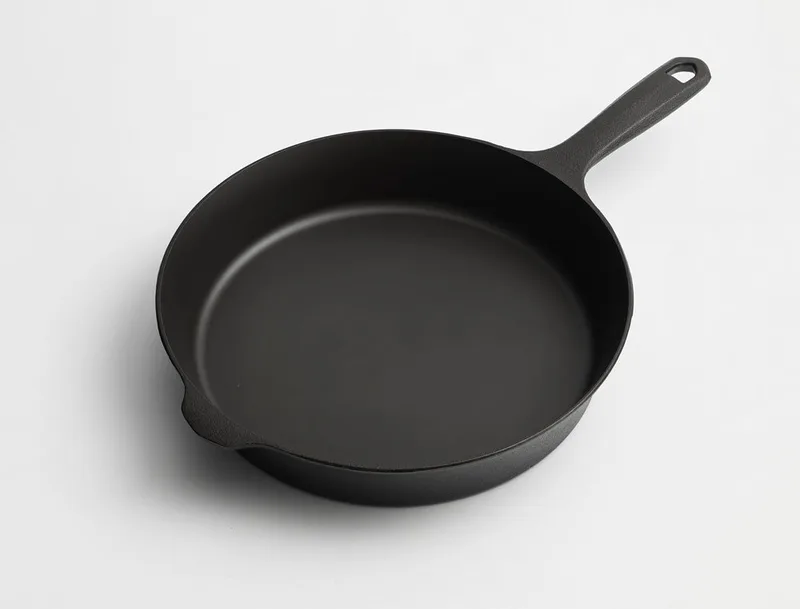
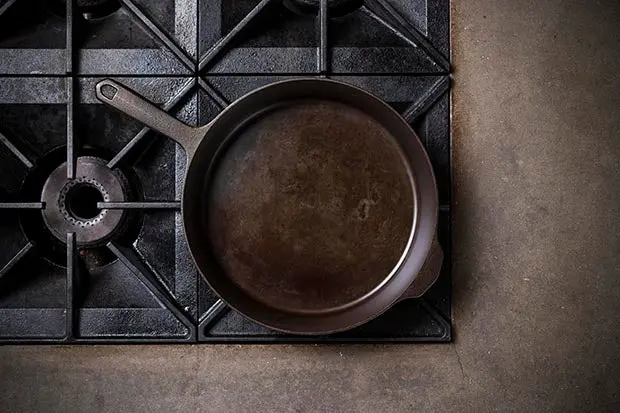
Part 05
The pan began with a 1930s Wagner and a flat refusal
The reason any of this exists is a family inheritance and a stubborn question. Field Company was started by two brothers, Stephen and Chris Muscarella, who named it after their maternal grandmother. From that side of the family they inherited a set of cast iron pans from the 1930s.

Both of them also bought modern cast iron, and both of them found they barely used it. In their words: “It wasn't as nice, it didn't have the same weight or hand feel. A question was born. Why don't they make them like they used to?”
The answer they got from industry was no. They took one of their favorite vintage pans, a Wagner from the 1930s, around to foundries, and, as they tell it, “We were told that there was no way that a modern foundry could pour iron that thin.”
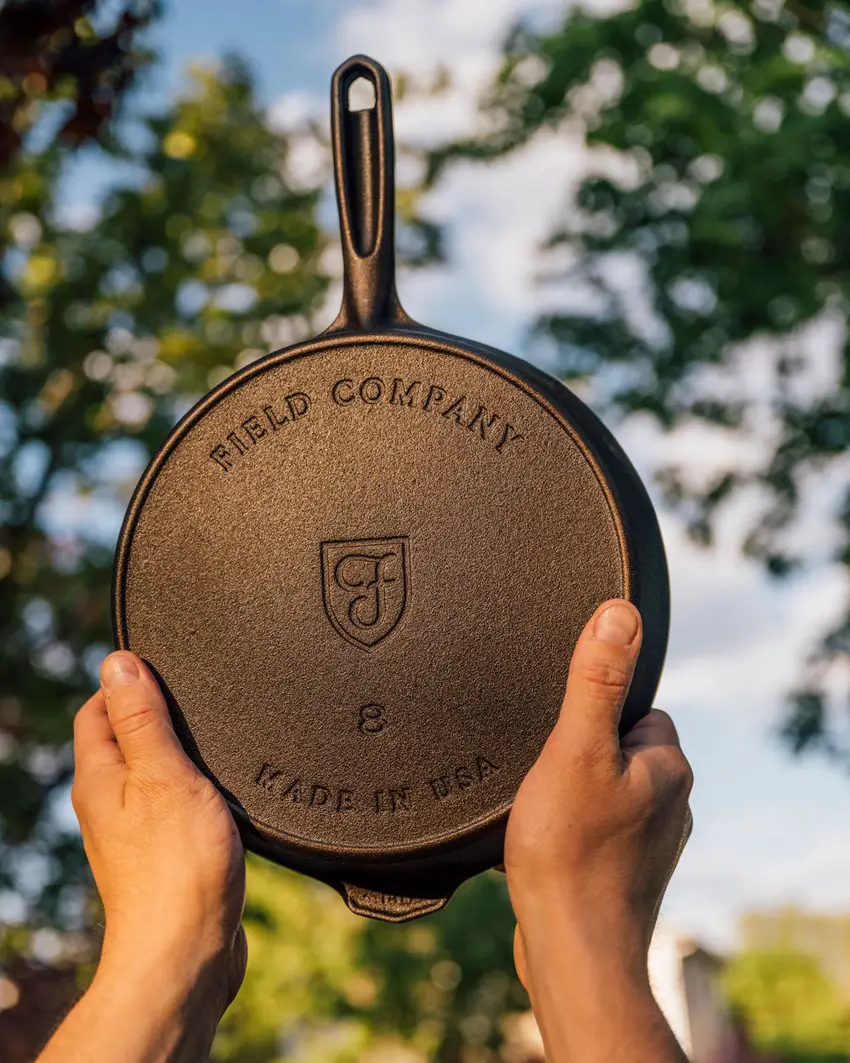
What happened next is the detail that makes the rest of this page credible. They went looking for a paper, and found one: Thermophysical Properties of Thin Walled Compacted Graphite Iron Castings, by a materials science professor in Europe. They emailed him. He agreed to a call, which they describe him finding “more than a little amused” by. With his help they put vintage and modern pans under microscopic imaging to compare the graphite structure of the iron itself, then visited his lab to learn to pour castings by hand.
What they were actually testing for
Not weight for its own sake. Thin walls are a metallurgy problem before they are a design choice, and Field states the constraint plainly:
“Thin walls require a strong microstructure, which in turn requires precisely calibrated flow rates and pouring temperatures at the casting stage.”
Pour too cool or too fast into a thin cavity and the casting is weak. That is why the cheap answer is a thick wall, and why a light skillet is harder to make than a heavy one.
They also went through a phase of stripping and restoring old pans, by sanding, by oven cycle, by fire, and finally by electrolysis, specifically to season smooth surfaces from scratch and compare them to modern machined ones. That is where the counterintuitive finding in Part 04 came from. In their summary: “certain kinds of smooth surfaces never build up good seasoning.” They learned it the slow way, on their own bench, before it became a machining spec.
How a machining spec was arrived at
The sequence Field describes on its own about page, in order.
- An inheritanceVintage cast iron from the 1930s, from their grandmother's side of the family, next to modern pans they found they were not using.
- A refusalA 1930s Wagner taken round to foundries, and the answer that no modern foundry could pour iron that thin.
- A paper, and its authorThermophysical Properties of Thin Walled Compacted Graphite Iron Castings. They emailed the professor. He took the call.
- MicroscopyVintage and modern castings compared under microscopic imaging, to see whether the old iron's graphite structure was real or folklore.
- Their own benchStripping and reseasoning old pans by sanding, oven cycle, fire and finally electrolysis, to find out which surfaces take seasoning and which never do.
Summarized from Field Company's about page as published on August 14, 2026.
Part 06
Why four and a half pounds, and not six
Weight is where cast iron loses most of its converts. A pan you cannot lift one handed with a chicken in it is a pan that lives in a cupboard. But lighter is not automatically better either, and Field puts a number on the window:
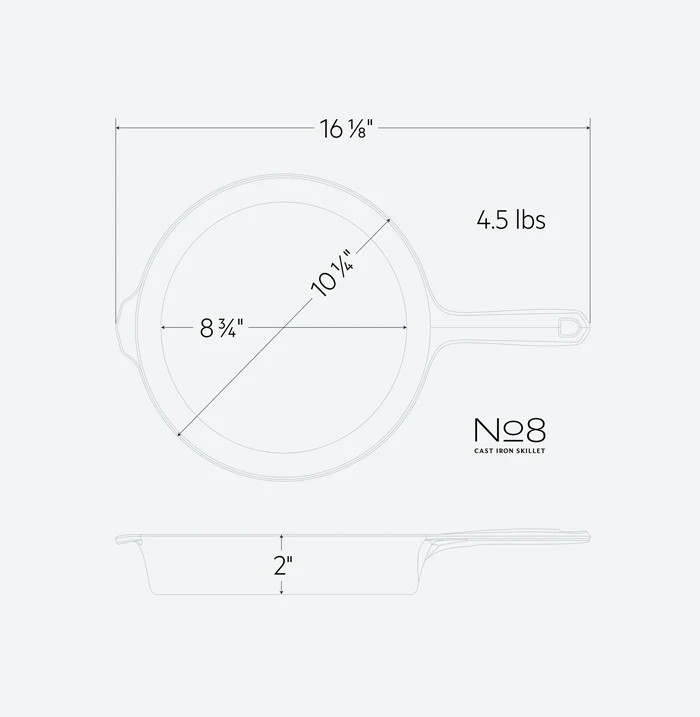
Their No.8, the 10 and a quarter inch pan, is listed at 4.5 lb. The rest of the range scales the way you would expect, and the numbers below are theirs.
Published weight, by size
Field Company's own specification table. The No.8 is the size the brand sells most and the one the sweet spot quote refers to.
Source: the specifications table on fieldcompany.com, read on August 14, 2026. Field's own dimensions panel gives 4.3 lb for the No.8 while the specification table and the technical drawing give 4.5 lb, which is the range they quote in the FAQ.
The ad Field is currently running says the same thing in one line, and it is the only ad copy on their account that explains anything: “We spent years studying our favorite vintage skillets to find the perfect balance between lightness and bottom heft for high heat searing and even cooking.”
Bottom heft is the operative phrase. Thin walls keep the pan liftable. A thicker base keeps enough thermal mass under the food that a steak does not drop the pan's temperature the moment it lands. Those two goals pull against each other, and the balance point is what the vintage pans were being measured for.
Part 07
Five things you only notice when you turn the pan over
Field publishes a page about design details that reads like an engineer's confession. Five of them are worth knowing before you buy any cast iron, from anyone, because each one is a decision every manufacturer makes and almost none explain.
1. The number on the handle is not inches
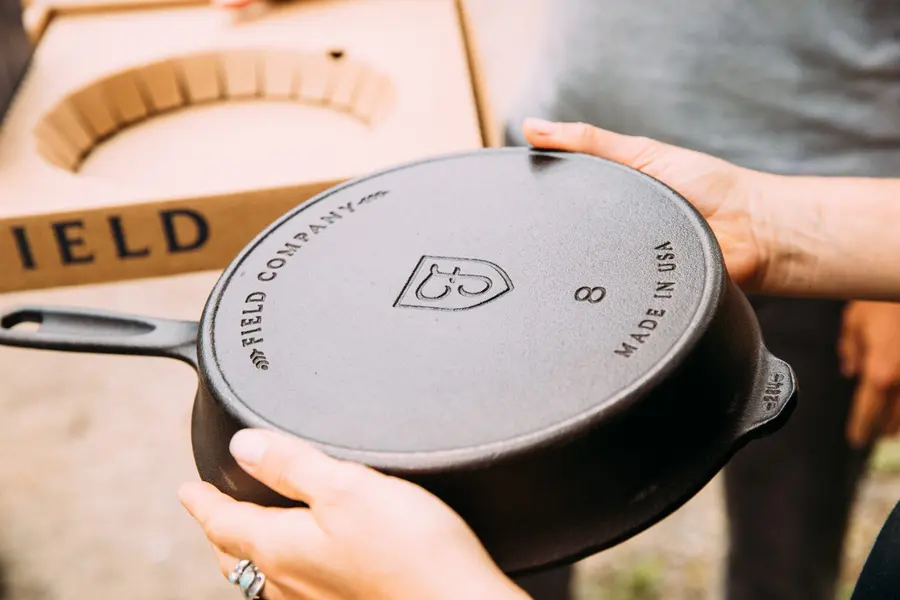
A No.8 skillet is not eight inches. Field's sizing follows the nineteenth century convention, where “the number corresponds not to diameter in inches, but to the burner ring size on an old-fashioned wood-burning stove.” Their No.8 measures 10 and a quarter inches across the top, with an 8 and three quarter inch cooking surface. If you have ever bought cast iron online and been surprised by what arrived, this is why.
2. There is a heat ring, and it is 0.04 inches
The raised ring on the underside is another wood stove inheritance: it dropped into the burner hole and held the pan in place. On a modern range it does a different job. Field's version is dimensioned so the pan sits flat and stable on glass and ceramic tops as it heats, and at four hundredths of an inch of clearance they state it does not interfere with cooking performance or cost anything on induction. Cast iron is naturally magnetic, which is the only thing an induction cooktop actually requires.
3. There are no pour spouts, on purpose
When the first Field skillet launched on Kickstarter, the loudest complaint was not the weight or the finish. It was the missing spouts. Their answer, after testing, was two sentences long: “A few quick tests exposed a basic flaw in this convention: pour spouts still drip!”
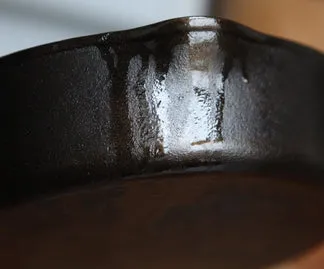
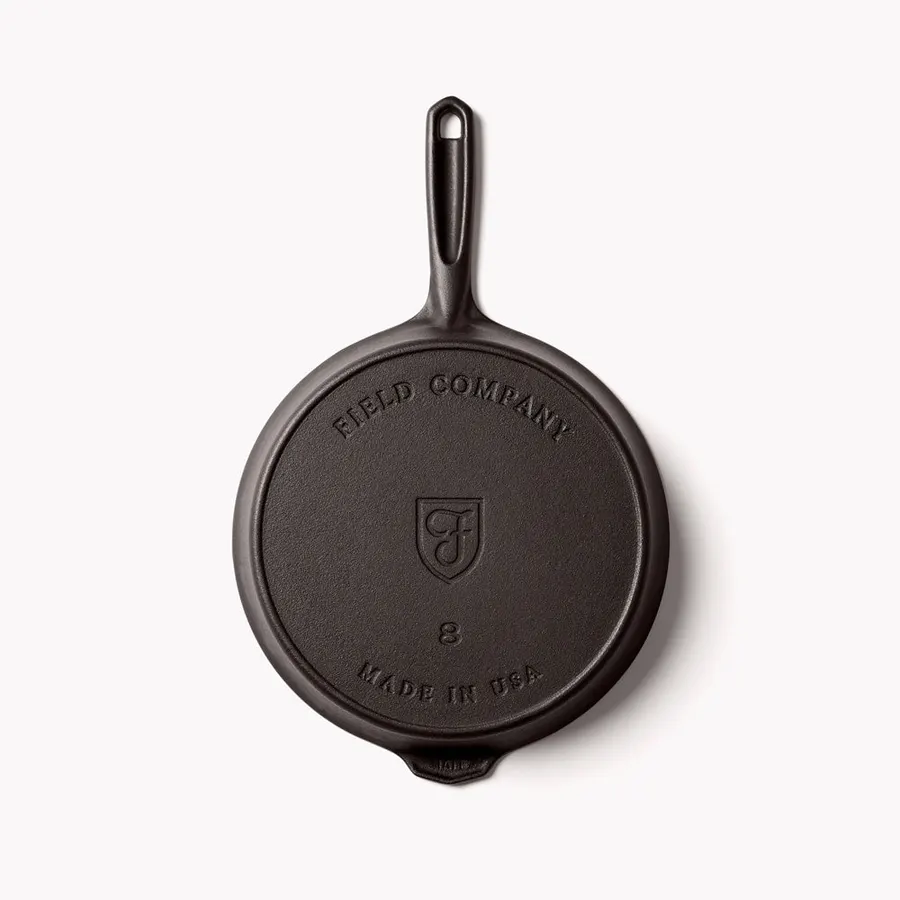
Removing them bought two things. The rim flares evenly all the way round, like a spoutless pitcher, so liquid leaves cleanly from any point rather than one. And the wall thickness stays uniform, which is what lets them keep weight down without weakening the casting. Wirecutter, quoted on Field's own page: “We found it easy to pour hot grease over the edge without dripping.”
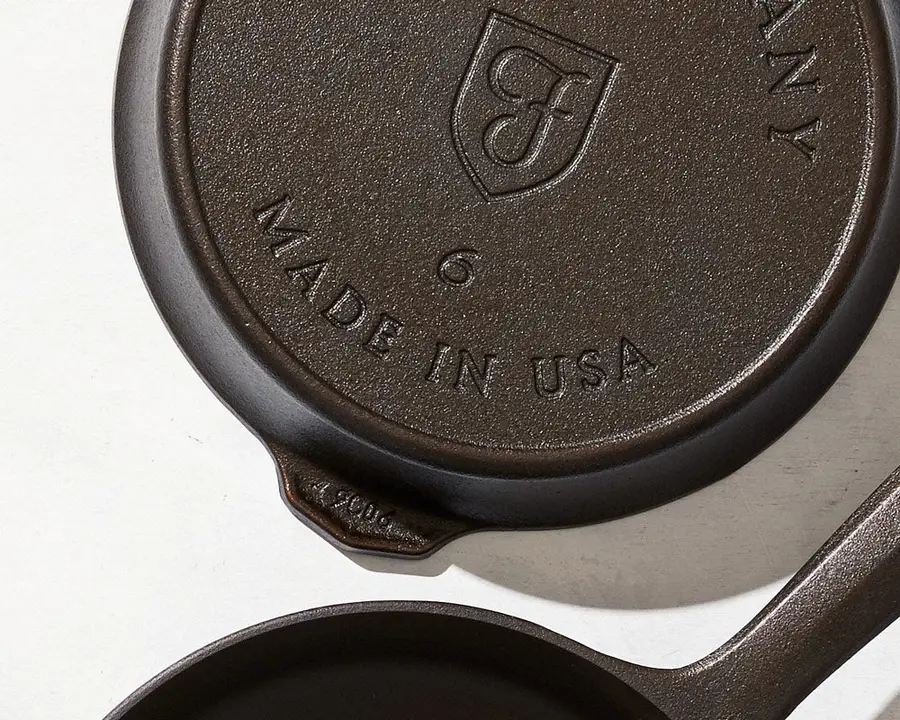
4. Every pan is stamped with the day it was poured
On the underside of the helper handle there is a short alphanumeric code in year, month, day order. Field gives two worked examples: 9C06 is March 6, 2019, and 1J21 is September 21, 2021. It is a vintage cookware convention, kept for no commercial reason at all, and it is the sort of detail that tells you what kind of company you are dealing with.
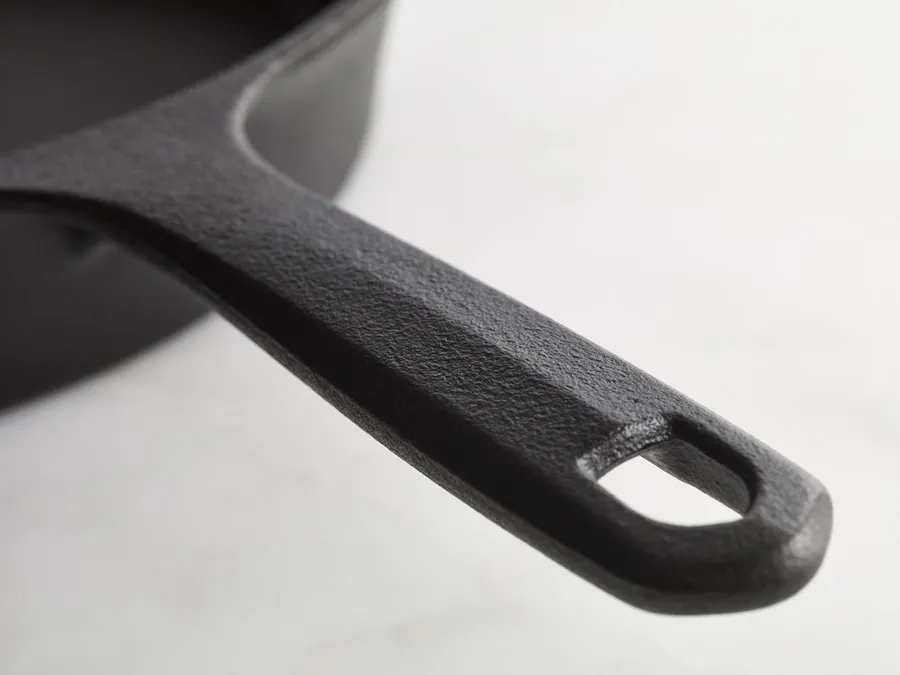
5. The handle is lighter than it looks, and shaped to be found
Field removed metal from the underside of the handle where it carries no load, which drops weight, and then did something less obvious: they calibrated the handle's length and balance so a fully loaded pan does not strain the wrist. A pan feels light or heavy at the hand, not on the scale. There is a ridge down the center so your grip locates itself without looking, and the hanging hole is shaped like the family shield.
Part 08
Which number belongs in your kitchen
Because the numbers are not inches, size is the single most common ordering mistake. One of Field's own reviewers, Bruce W. M., left four stars and used the space to warn other buyers about exactly that: he cooks bacon and eggs in the No.8, reckons three slices of bacon is about all it will take before they bunch up, and finished with the plainest possible advice: “Make sure to get the size you need.”
The five sizes, drawn to scale
Top diameters, in proportion. The No.8 is the one Field sells most and the one their sweet spot weight refers to.
No.12 13 3/8 in
No.10 11 5/8 in
No.8 10 1/4 in
No.6 8 3/8 in
No.4 6 3/4 in
No.8 cooking area 8 3/4 in
The inner gray disc is the flat cooking surface of the No.8, not its top diameter. That gap is the second reason people order a size too small.
| Size | Top diameter | Cooking surface | Weight | Field's suggested use |
|---|---|---|---|---|
| No.4 | 6 3/4 in | 5 3/4 in | 1.86 lb | One serving. Fried eggs. |
| No.6 | 8 3/8 in | 7 in | 3 lb | One to two servings. Scrambled eggs. |
| No.8 | 10 1/4 in | 8 3/4 in | 4.5 lb | Two to four servings. Three or four chicken breasts. |
| No.10 | 11 5/8 in | 9 3/4 in | 6 lb | Four to six servings. A whole roast chicken. |
| No.12 | 13 3/8 in | 11 1/2 in | 8 lb | Six to eight servings. Deep dish pizza. |
All figures from Field Company's published specification and size guide, read on August 14, 2026. Cooking surface figures come from their specifications table.
Part 09
The first twenty meals decide the next twenty years
If seasoning is grown rather than applied, then the early cooking is not maintenance. It is manufacturing, and you are doing it. Field asks for fifteen to twenty sessions of deliberate breaking in, and their instructions are unusually specific about what to avoid.
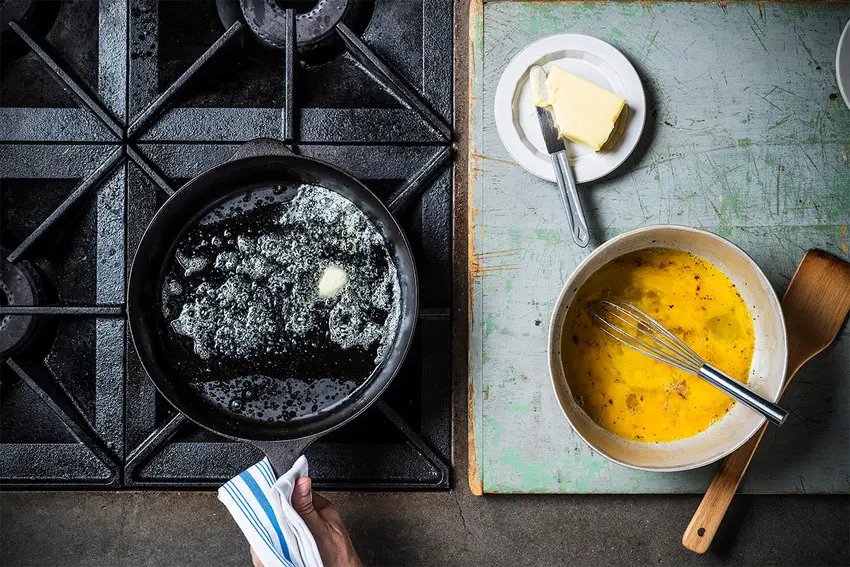
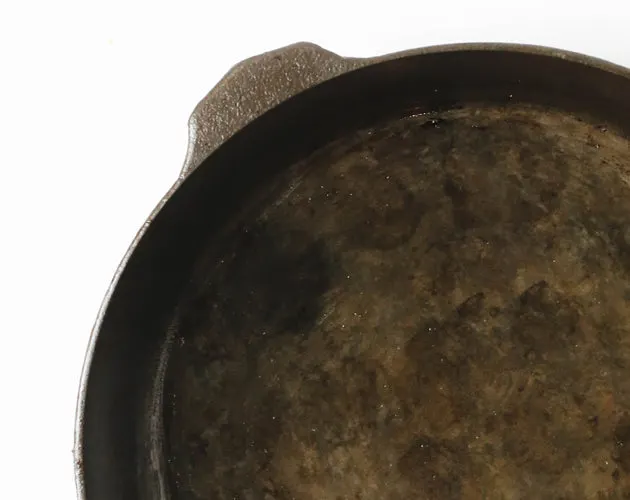
- Cook with fat, and more of it than feels normal. Field's line is a couple of tablespoons of oil or a good hunk of butter, and they add: do not be afraid to add more.
- Keep the heat low to medium at first. Their suggested starter dishes are caramelized onions, fried chicken and cornbread, not a screaming sear.
- Keep acid out for now. Tomatoes, wine, citrus and vinegar eat seasoning, and a lightly seasoned pan can pass a metallic taste into acidic food. After the pan is broken in, a little acid is not a problem.
- Expect patchiness, and let it be. Field says patchy seasoning is actually a good thing, because it lets layers interlock and strengthen each other rather than sitting as one uniform sheet.
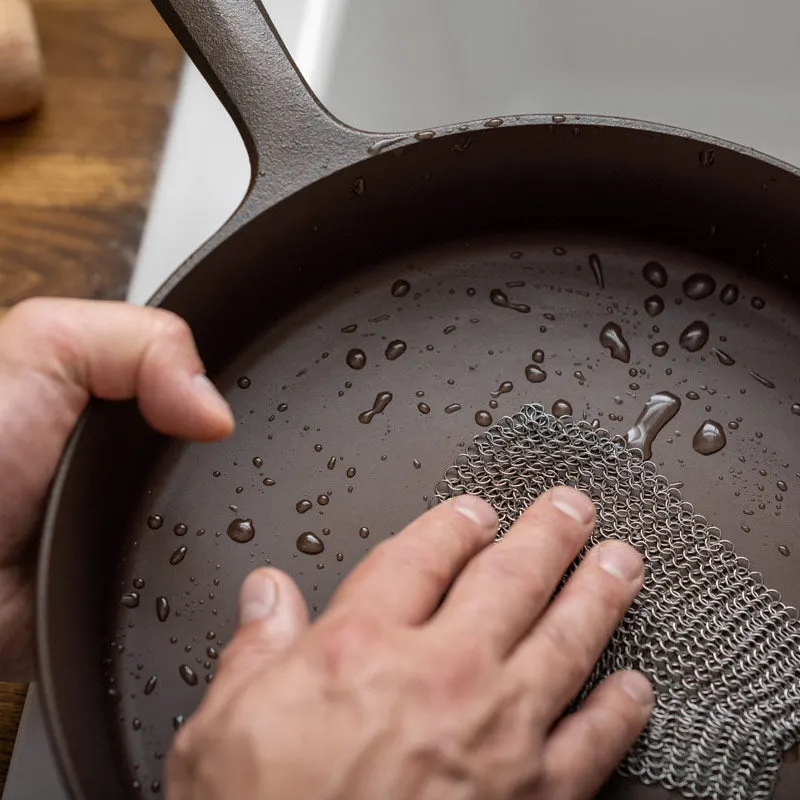
- Hand wash, dry on the stovetop. Never the dishwasher, never drip dry, never store wet. Warm it on the burner to drive off the moisture.
- Preheat gently. Their guidance is up to five minutes on low before you start cooking, which is also how you avoid the hot spot that makes food stick in the middle.
The oven seasoning argument, settled
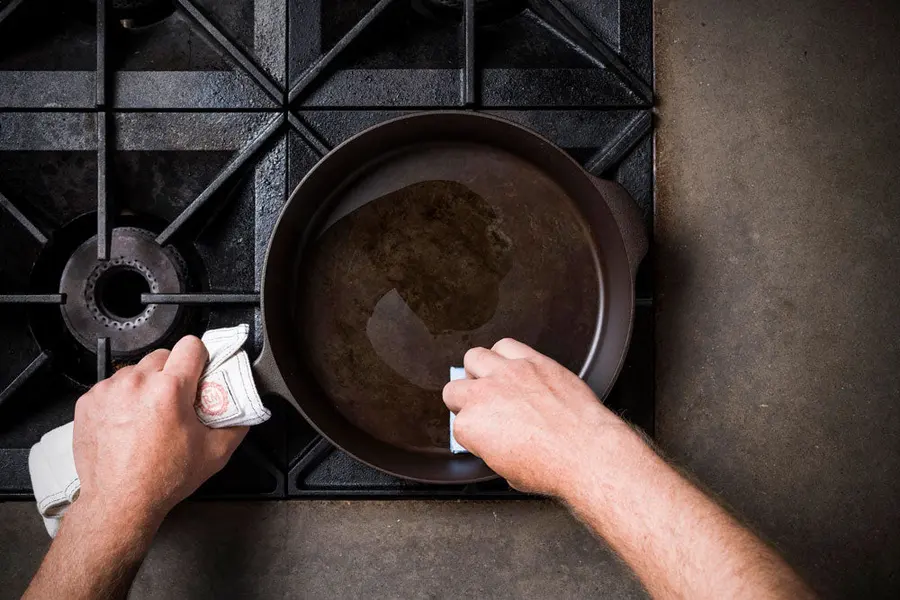
You do not have to oven season a pre-seasoned pan, and Field's own preferred method is simply to keep cooking. If you do want to speed things up, their tested schedule is the opposite of the internet's: start at 200°F rather than blasting the oven, step to 300°F, then 400°F for one hour, wiping the pan back to a dry matte finish before it goes in.
Their oil advice is equally against the grain. Grapeseed and sunflower, both high in polyunsaturated fats. Not flaxseed, despite its popularity online, because they find the seasoning it produces is “brittle and prone to flaking.” Not lard or coconut oil either, which are too saturated to open enough bonding sites.
Field's oven schedule, if you insist
Against the usual internet advice to run the oven as hot as it goes. Their reasoning is that the target sits just below the oil's smoke point, and that a slow ramp bakes seasoning into the surface rather than onto it.
Then an hour curing in the switched off oven with the door shut. Wipe the pan back to a dry matte finish before it goes in. Field's own note: doing this once does not mean the pan is finished, it just gives you a base coat to build on.
Part 10
What the people cooking on them say
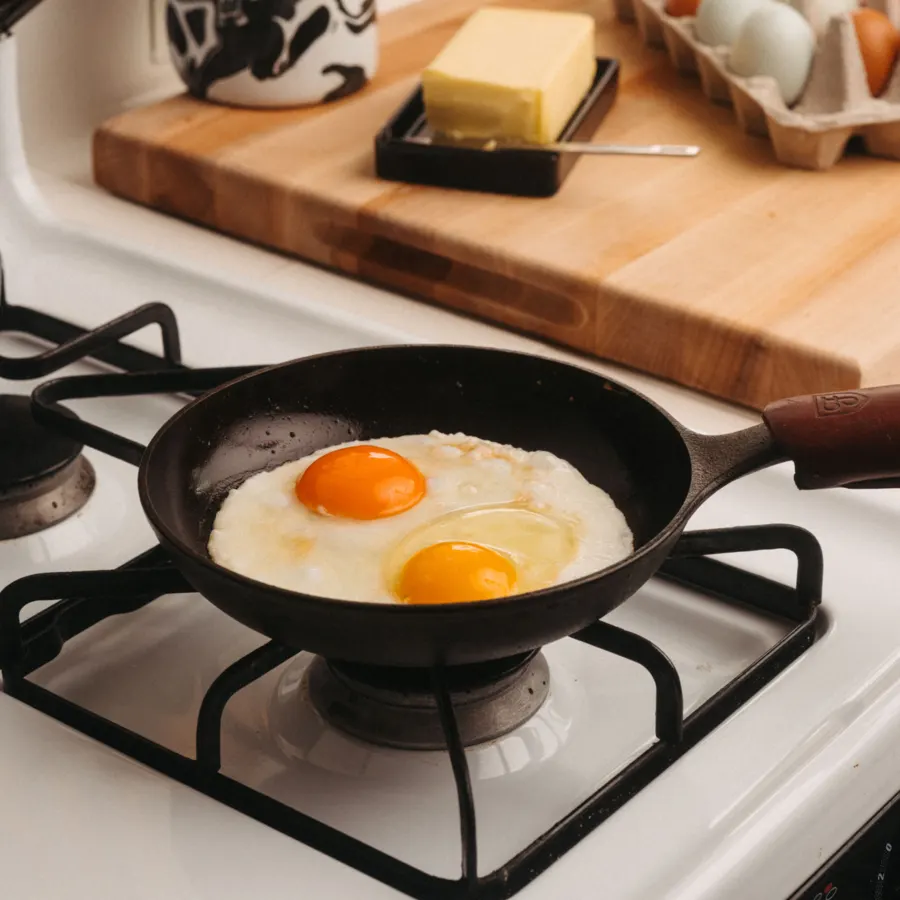
The No.8 carries 1,083 reviews on Field's own site at an average of 4.9, with 98 percent saying they would recommend it. A few of the recent ones, quoted as published, including the critical one.
★★★★★
Beautiful, beautiful industrial design. Very non-stick like my Griz. The handle gets surprisingly hotter, much hotter than my Griz, but I love it anyway. Bought 2, one for my summer house and one for my primary res.
Tom R.Verified buyer · cooks on induction · review titled “Skillet Review vs my Griswold”
★★★★★
Cooked like a dream from the beginning. Keeps getting better.
Robert C.Verified buyer · cooks on gas
★★★★☆
I have the #8 pan. Cooking surface is 10 1/inches. ... I have cooked in it 6 times, just eggs snd bacon. ... It turns dark right after my first use with frying two eggs. I guess thats normal. Make sure to get the size you need.
Bruce W. M.Verified buyer · cooks on gas · review titled “Size Matters”. Quoted with cuts marked, spelling as published; he also wished he had ordered the No.12.
★★★★★
Best cast iron pans virtually non stick, very satisfied
Carl L.Verified buyer · cooks on gas
★★★★★
We use this skillet often and it has not been a disappointment.
Ron O.Verified buyer · cooks on an electric glass top
What reviewers have written, as reproduced on fieldcompany.com
Field Company makes lightweight, beautifully smooth cast iron pans...the No. 8 pan has been a winner in our review for years.Serious Eats
Field Company makes some of, if not the best, overall cast-iron skillets on the marketGear Patrol
A modern classic, designed to be lighter, smoother, and easier to handle than your average cast ironNew York Post
This pan is beautiful.Food & Wine
Part 11
What it costs to stop buying pans
The No.8 is $165 as published today. That is more than a nonstick pan and it is meant to be the last one, which is a claim you should make a company put in writing. Field does: 45 days to cook on it in your own kitchen and return it for a full refund if you do not want it, and a lifetime warranty that reads, in their words, “if it cracks, breaks, or warps under normal cooking conditions, we'll replace it.”
They also make the honest distinction that most warranties bury. Sticking, uneven seasoning and light rust are not defects, they are surface states, and their answer to all three is care and more cooking rather than a replacement.
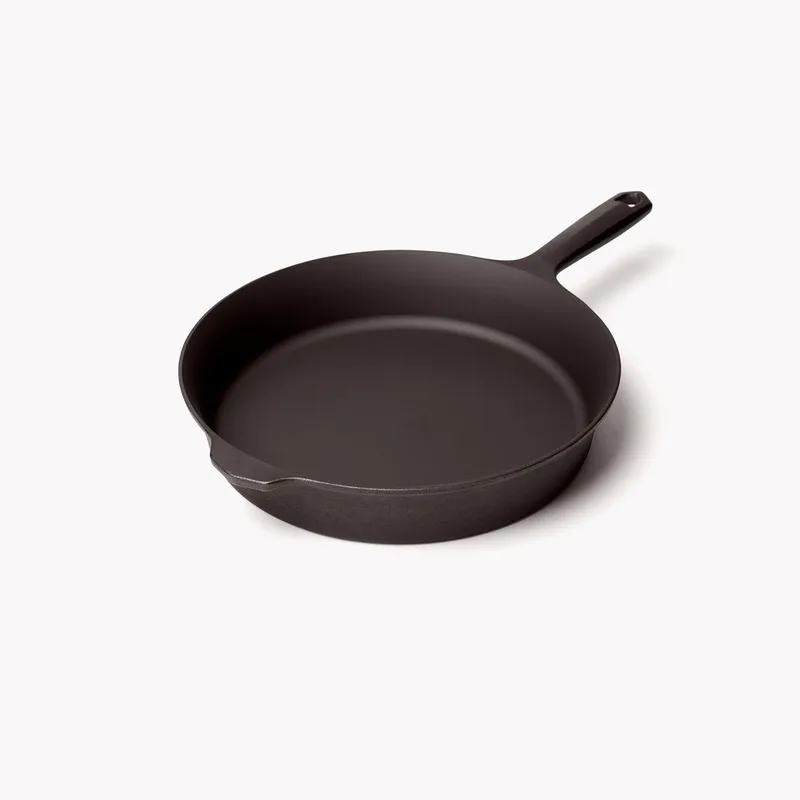
Field No.8 Cast Iron Skillet
10 1/4 in across, 8 3/4 in cooking surface, 4.5 lb
$165 as published on fieldcompany.com
- Machined smooth, then left with the controlled texture that seasoning needs to bond.
- Pre-seasoned with three baked coats of organic grapeseed oil. Ready to cook, not finished.
- Cast in the USA from recycled iron, using green sand casting, the method Field says Griswold and Wagner used.
- No PFOAs, no PTFEs, no synthetic coatings. Field's summary is iron and oil.
- Works on induction and on glass and ceramic tops. Cast iron is magnetic, which is all induction asks for.
- 45 day trial and a lifetime warranty. Free US shipping over $100 per their current site banner.
One more thing worth knowing about how this pan came to exist. Field's own product page mentions it in a single line under the title: the No.8 is the pan that raised $1.6 million on Kickstarter. People put up $1.6 million for a lightweight, machined cast iron skillet before one existed, on the strength of an argument about surface texture and wall thickness. The argument has not changed since.
Another of Field's ads runs a customer line that needs no commentary. Robert M., dated March 2025: “I love using this pan so much I threw out my other pans.”
Part 12
The questions people actually ask
Do I need to season it before I use it?
No. It ships with three baked coats of organic grapeseed oil and you can cook on it out of the box. It will not be fully nonstick yet, and Field says so rather than pretending otherwise. Oven seasoning is optional, and their preferred method is to keep cooking.
Will it work on my induction cooktop?
Yes. Cast iron is naturally magnetic, which is what induction requires. Field notes their heat ring is dimensioned so the pan sits flat and stable on glass and ceramic tops, and that the clearance does not cost anything on induction.
Can it go in the dishwasher?
No. Field's published care instructions are hand wash only, never the dishwasher, then towel dry and warm the pan on the stovetop to evaporate the moisture. Never drip dry and never store it wet. Their other instruction is the easy one: cook often.
What if the seasoning goes wrong?
Their position is that most surface problems, sticking, uneven seasoning, light rust, are not defects but stages, and that care plus more cooking fixes nearly all of them. The lifetime warranty covers what care cannot: damage on arrival, cracks, breaks and warping under normal cooking.
Is a lighter pan a weaker pan?
Not if the casting is right, which is exactly what the brothers spent their research on. Their stated constraint is that thin walls need a strong microstructure, which needs precisely calibrated flow rates and pouring temperatures at the casting stage. Thick walls are the cheap way to avoid that problem.